 Powered by SlotsReach.com

ELK Studios has a reputation for doing weird and wonderful things with grid slots, and Micro Knights is no exception. On top of the usual cascades, where winning symbols just vanish, ELK has added a genuinely clever “Queue” system that takes the action right off the board.
It’s got a lot of charm and some brilliant chain-reaction potential, but it also has a few quirks that might frustrate hardcore players.
Visuals and Design: Charming, But Needs More Color
The game is played from a top-down perspective, setting a medieval castle frame deep in a lush pine forest. The character design is classic ELK, goofy and highly expressive. Your high-paying symbols are wide-eyed farm animals (a bull, a goat, a rabbit, and a brilliantly screaming frog).
My one gripe? The low-paying symbols.
The lower half of the paytable consists of a slab of meat, a water well, a mushroom, and an archery target. On a large 7×7 grid, these symbols are quite small. Worse, all four of them are varying shades of brown and beige. When the board is cascading quickly, these symbols blur into one warm, muddy smudge. Tracking your clusters becomes harder than it needs to be, which is a shame for a game that relies so heavily on visual momentum.
The Queue: The Star of the Show
The standout feature of Micro Knights sits completely outside the 7×7 grid. At the bottom of the screen, you’ll notice a stone path. When rows of symbols are shoved off the board, they don’t disappear: they land on this road, stack up by symbol type, and stay active.
If you start forming a cluster on the main grid, any matching symbols waiting in the Queue will instantly join it. For example, if you have four frogs on the board and two sitting in the Queue, they link up to form a paying cluster of six. It’s a brilliant mechanic because a spin that clears a row off the screen is actively setting up your next win.
Feeding this Queue are two animated characters standing by the reels:
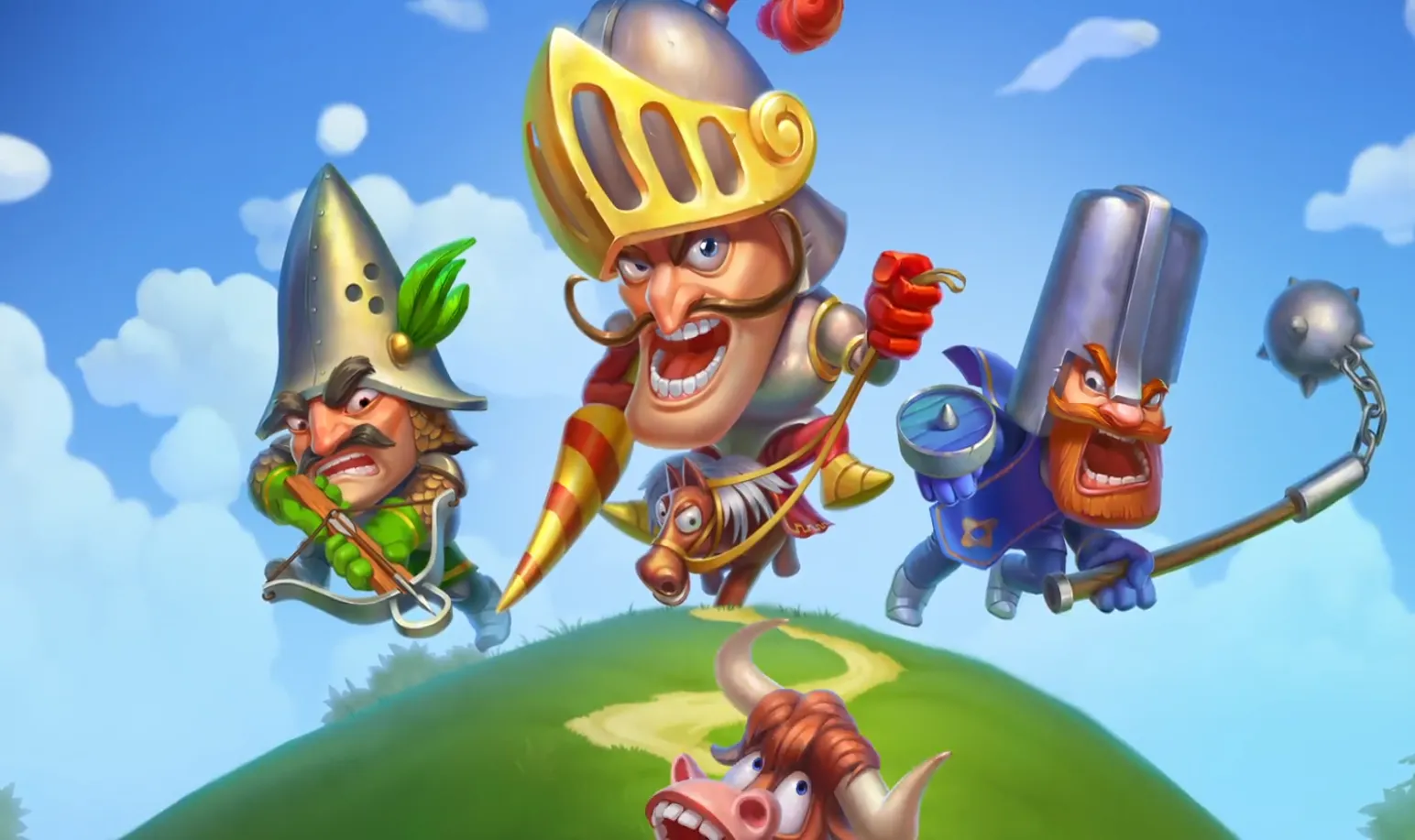
- The Charging Knight: Dashes across the board, shoving an entire row of symbols off the grid and into the Queue (leaving wilds and scatters behind).
- The Smashing Knight: Doesn’t move symbols, but adds one extra symbol to every stack already sitting in the Queue, fattening up your reserves without stripping the main board.
The Meter: An Escalating Climb
Every winning symbol feeds a meter on the right side of the screen, though wilds and symbols joining from the Queue only count once. Fill it, and the Collecting Knight awards a flag modifier.
The meter gets progressively harder to fill. The first flag takes 20 symbols, the second takes 30, the third 40, and so on. The modifiers trigger in a strict order:
- Inferno: Burns away all low-value symbols.
- Extra Wilds: Drops 3 to 15 golden chalice wilds onto the grid.
- Super Size: Drops a big 2×2, 3×3, or 4×4 symbol.
- Charge: Pushes 2 to 5 rows straight into the Queue.
- Epic Charge: Dumps the entire board into the Queue.
- Boosted Queue: The grand finale. Every single stack in your Queue connects to the grid at the exact same time.
Because of the escalating cost, you’ll trigger the early flags often, but reaching those late-stage Queue dumps requires a seriously hot cascade.
Free Drops: Short, Sweet, and Persistent
Land three bonus scatters, and you trigger the Free Drops feature. You only get 5 drops, which sounds incredibly stingy on paper. However, ELK has balanced this with a neat twist: neither the Queue nor the Meter resets between drops.
The bonus does start from scratch, with an empty Queue and an empty Meter, so whatever you had built in the base game stays behind. But if the first drop gets a cascade going, everything it shoves onto the road and every flag it banks carries into the next four, and that is where those 5 drops can turn into a powerhouse. (Note: There is no way to buy the feature here, so you have to earn this feature the old-fashioned way).
Why Bigger Clusters Don’t Always Pay More
If you’re a math nerd, you’ll notice ELK has done something strange with the paytable. It’s built entirely around crossing thresholds rather than incremental gains.
The top-paying Bull maxes out at 250x for a cluster of 20+. But the middle of the paytable is completely flat. For instance, landing 12, 13, 14, or 15 Bulls all pay the exact same amount. You don’t see a bump in your payout until you cross the next threshold at 16 symbols. It can be a little frustrating to watch a cluster grow by three symbols and realize it didn’t add a single penny to your win.
The RTP is 96.0%, and the max win is capped at 2,500x your stake. By modern high-volatility standards, that’s quite low. Hitting that cap takes a round that simply refuses to die, ideally one that pushes all the way to the 6th flag to slam dozens of queued symbols back onto the board at once.
Still, it’s not for everyone. The muddy colors of the low-paying symbols, the flat paytable thresholds, and the relatively low 2,500x max win might turn off hardcore volatility chasers.