
 Powered by SlotsReach.com

Kamo Insect Hunter is a very high volatility slot from Backseat Gaming. Built around a 5×5 grid and a massive progressive multiplier ladder, this game is all about the setup.
But is the hunt actually worth your bankroll, or will this one just drain your balance? Here’s the good, the bad, and the brutally volatile.
The Core Mechanic: Climbing the Multiplier Ladder
Everything in Kamo Insect Hunter revolves around pushing the global multiplier, which sits temptingly above the reels, as high as possible.
The star of the show is the Kamo Wild Reel. When this lands and expands, it fires between one and six “nets” across the board. Each net bumps you up one step on the multiplier ladder, which maxes out at 200x. Whatever number you land on is applied to all line wins for that spin.
The wild reel doesn’t seem to expand just because it landed. The rules don’t say so outright, but in play it only stretched when the stretch could complete a winning payline. When it couldn’t connect with matching symbols, it stayed a single, useless wild cell, no nets fired, and the multiplier didn’t budge.
If you’re a fan of Hacksaw Gaming, you’ll find a similar rule in its Supernova Shooting Stars, due on 5 November 2026, where the Stars spread only when they’re part of a win. From a design standpoint, I actually like this: it spares you from sitting through long, flashy animations that result in a zero-dollar payout. But as a player, it can be frustrating to see a special symbol land, only to realize it’s a dud.
The Base Game: Prepare for a Grind
Let’s not sugarcoat it: the base game economy here is tough. Because Backseat Gaming has put all the power into that multiplier ladder, the standard paytable is incredibly weak.
Across the 15 fixed paylines, a five-of-a-kind of royal symbols pays 1x or less. Even the premium hunting gear tops out at just 20x for a full line. To put that in perspective, a full screen of the best symbol in the game pays a mere 300x if a multiplier isn’t involved.
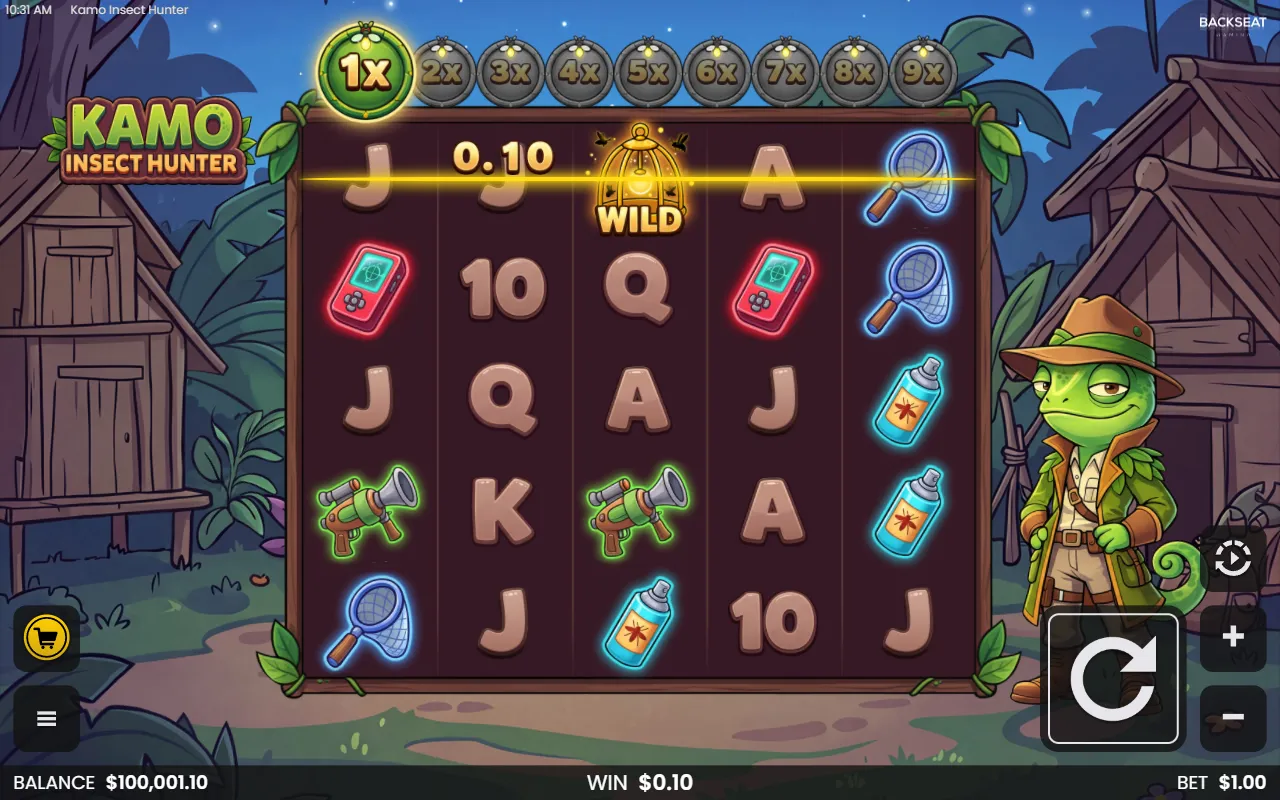
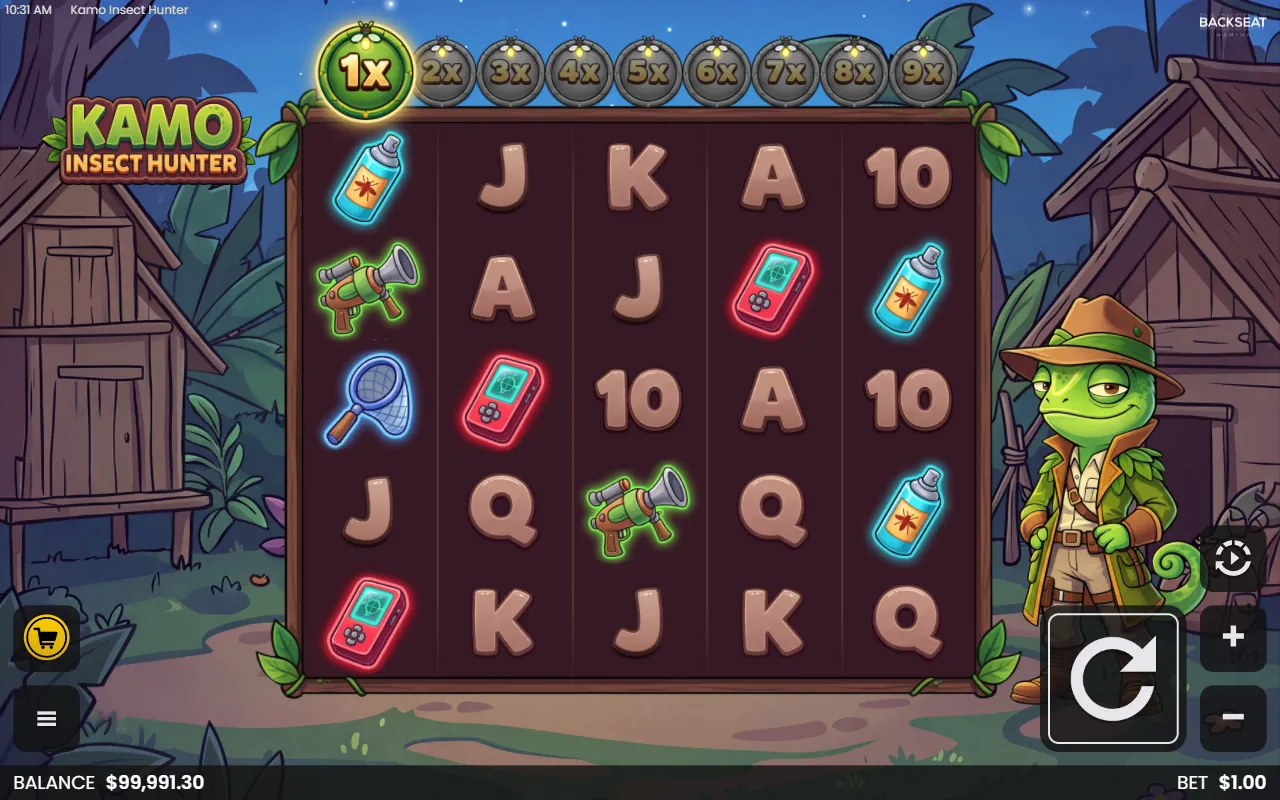
Because the multiplier resets to 1x after every single base game spin, you are entirely reliant on catching lightning in a bottle on a single drop. During my session, the volatility was on full display. I had one decent early hit where a wild reel fired three nets, pushing the ladder to 4x and turning some cheap bug spray symbols into an okay payout. After that? A whole lot of 0.1x wins and a brutal stretch of about 20 dead spins where nothing happened at all.
The Bonus Rounds: Three Tiers of Potential
To get anywhere near the game’s 10,000x max win, you need to trigger the free spins. But Kamo Insect Hunter features three different bonus tiers, and your potential varies wildly depending on which one you land.

- 3 Scatters (Net Catch): You get 10 free spins, but this feature is a bit of a letdown. The base game rules still apply, meaning the multiplier resets after every spin. To hit big here, you need multiple wild reels to land and fire maximum nets on the exact same spin. It’s tough to pull off.
- 4 Scatters (Bug Hunt): Now we’re talking. You get 10 free spins, but the multiplier becomes persistent. If you build the ladder up to 15x on spin two, it stays there (or goes higher) for the rest of the bonus.
- 5 Scatters (Kamo Frenzy): This is the Holy Grail of the game. The multiplier is persistent, but crucially, every Kamo Wild Reel becomes sticky. They stay on their columns for the rest of the round, and they fire a fresh batch of nets on every single spin.
Kamo Frenzy is where the game’s math model truly shines. On paper, sticky wilds that feed the ladder every spin while also widening your payline connections are the whole thrill of this game. It creates a compounding snowball effect that turns your final few spins into a dense grid of wilds and massive multipliers.
If you like games with steady, medium-sized base game hits, look elsewhere. The base game here is a grind, and the 3-scatter bonus can be incredibly anti-climactic. However, if you have the bankroll and the patience to hunt for the 4-scatter or 5-scatter bonuses, the compounding mechanics of the sticky wilds and persistent multipliers are genuinely top-tier.