
 Powered by SlotsReach.com
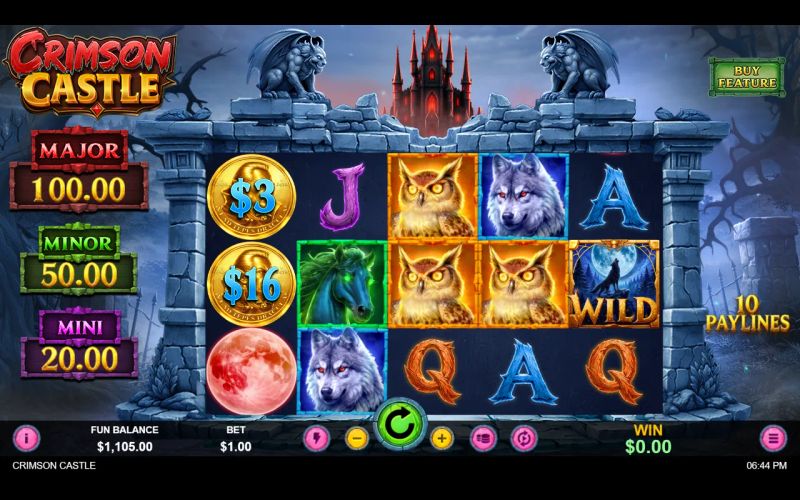
RTG’s Crimson Castle is not a game you play for a thrilling base game. If you’re booting up this 5-reel, 10-payline gothic release expecting massive line hits and constant action, you’re in the wrong castle. This is a medium-volatility game built entirely around a single Hold & Spin feature.
But is the feature worth the wait?
The Base Game: Line Wins with Fangs
The payout structure makes it painfully clear where the real money lives. The top-paying Wolf symbol returns a respectable 25x your total bet for a five-of-a-kind match, but after that, the paytable drops off a cliff. The royal symbols at the bottom of the ladder actually pay less than your stake for a three-of-a-kind combo. You aren’t playing this release to line up bats and owls; you’re playing to chase the Golden Coins.
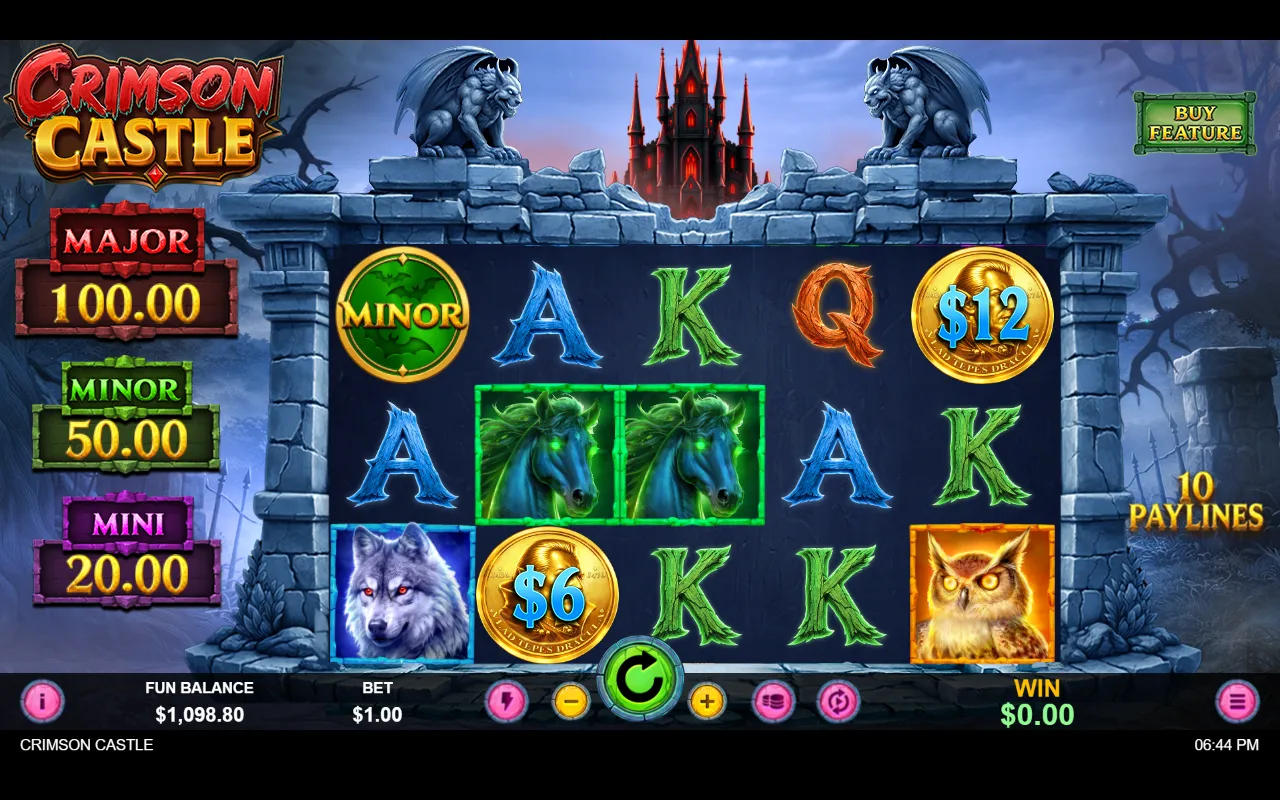
During my test sessions, the base game felt like a quiet stretch of near misses. Golden Coins, Moons, and jackpot symbols land frequently across the grid, but outside the bonus, they’re just dead weight. They hold no value until you land six of them on a single spin.
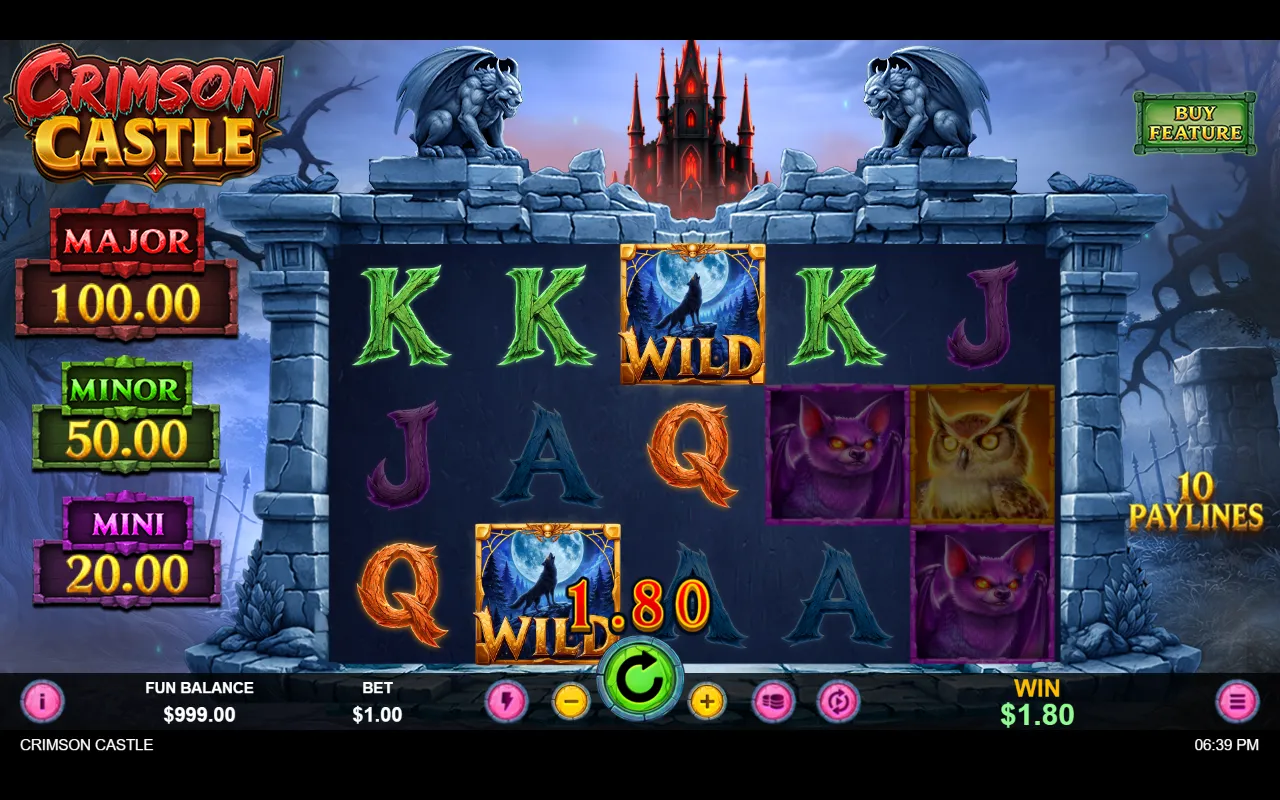
In one short stretch of 30 spins, my hit rate was hovering around 30%, but mostly in fractional amounts. A cluster of bats helped by a wild returned a measly 5.2x, while other minor hits brought in 1.8x. Mostly, the board just teased the feature. I had a 50x Minor jackpot coin land next to two Golden Coins, paying nothing because I missed the six-symbol trigger. The game constantly shows you the money, but it rarely lets you cash it in.
The Hold & Spin Feature
When you finally land those six Special Symbols, the standard symbols vanish, the coins lock in place, and Crimson Castle suddenly bares its teeth.
You get the standard three respins, resetting every time a new Golden Coin, Moon, or jackpot symbol lands. The round ends when you run out of spins or hit the game’s 5,000x max win cap.
The defining mechanic here, and the reason to actually play the game, is the Moon symbol. When a Moon lands during your respins, it collects the current value of every Special Symbol on the board, including the fixed Mini, Minor, and Major jackpots.
Here’s the brilliant part: the collected symbols stay exactly where they are. At the end of the round, the game pays the Moon’s accumulated total alongside the individual values of all the locked coins. Effectively, landing a Moon doubles the value of your entire board the moment it hits. If you can land a Moon late in the feature when the board is full, the payout potential is massive.
A Note on Multipliers: The game also assigns multipliers to random positions on the grid during the bonus. If a coin lands on a marked spot, it takes that multiplier. It sounds like a great way to juice your total, but in practice, it’s hit-or-miss. During one of my natural triggers that ran for eight respins, a couple of multipliers appeared on the board but never found a symbol to enhance. A multiplier on an empty space is just window dressing.
Elsewhere in RTG’s Catalogue
RTG has built several Hold & Win titles on this kind of chassis. If you’ve played Coyote Cash 2, you’ll recognize the collect mechanic, though that game stops at a 1,000x limit. Crimson Castle pushes its potential to 5,000x, giving the Moon’s double-paying collection a lot more room to breathe.
Among RTG’s other gothic titles, Count Spectacular is rated high volatility and goes up to a 10,000x cap, though it runs on a different mechanic entirely.
The Verdict
Everything in Crimson Castle funnels into that one specific Hold & Spin sequence, on a 96.25% RTP. The base game is just a countdown timer, and the standard line wins barely keep your balance afloat while you wait.
There’s no constant base-game action here. What there is: a lot of dead spins between you and the chance to lock a screen full of coins and watch a Moon sweep the board to pay it all twice. For a bonus hunter, that makes Crimson Castle a fair gamble.
Pros
- The Moon symbol’s “double-dip” collection mechanic is genuinely exciting.
- Solid 5,000x max win potential.
- Fixed jackpots are available in the bonus round.
Cons
- Base game payouts are incredibly weak.
- Lots of frustrating “near-miss” bonus teasers.
- Grid multipliers often land on blank spaces during the bonus.